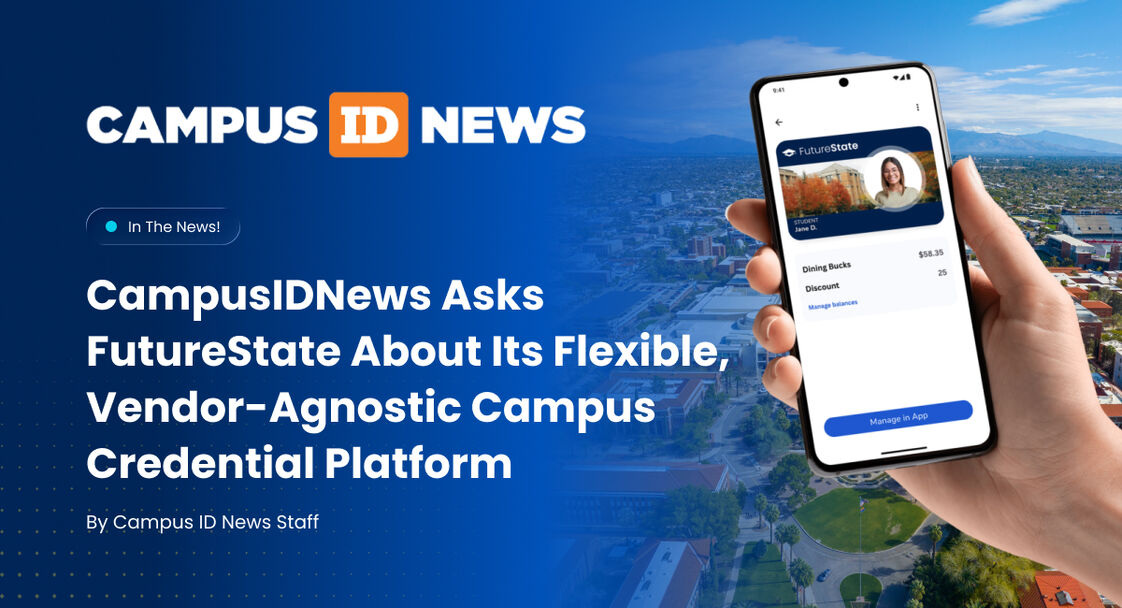
CampusIDNews recently interviewed FutureState about how its connection to the University of Arizona informed its vendor-agnostic, campus credential platform approach to its CardSync™ and CardPulse™ systems.
This article was originally posted on www.campusidnews.com, Friday, April 17, 2026
Built Differently With End-Users and Institutions in Mind
In a recent article, CampusIDNews asked the FutureState team what inspired them to build the vendor-agnostic platform that manages campus credentials and the systems connected to them.
FutureState’s founders wanted to address the limitations they had experienced using conventional campus credential programs, to eliminate vendor lock-in and introduce greater transparency systemwide. The result was the FutureState system, a simpler approach that puts institutions in more control of their campus systems. With FutureState’s CardSync™ and CardPulse™ systems, organizations no longer are handcuffed to a single vendor to manage how credentials connect to downstream systems. Instead, they can access an open interface model designed to support flexibility across campus services.
That work became the foundation for FutureState.
Why the Story Matters
According to CampusIDNews, many institutions are still working through the same integration challenge, trying to interconnect discrete and often incompatible systems implemented over time. The result was a gerryrigged platform, piecing together access, housing, dining, events, parking, and other campus services. Connecting systems not designed to operate as a single, connected environment resulted in complexity, limited visibility, and long-term dependency on vendor-controlled infrastructure.
The CampusIDNews noted how FutureState addressed those issues through:
- CardSync serves as the connection point for cross-campus service integrations, ensuring institutions can keep all systems aligned in real time.
- CardPulse is designed to provide a single point of visibility for administrators to monitor credentials, troubleshoot issues, and manage activity across the enterprise.
A Foundation Built for What Comes Next
The FutureState model also equips institutions with a practical foundation that improves operations now while maintaining flexibility for future technology decisions.
That includes support for physical credentials today and a cleaner path to mobile credentialing through an open integration layer, which enables campuses to adapt and update systems over time without requiring a complete rebuild to accommodate a single vendor.